
Right now, most UK mobile networks support both Wi-Fi Calling and VoLTE (Voice over LTE), which let you use your phone to call and text as normal when connected to a Wi-Fi or 4G network.
Without this, you’d only be able to call over 2G or 3G – if there wasn’t a 2G or 3G signal, you wouldn’t be able to make or receive calls, and if there was, your phone would switch to this while you were on the call, rather than using faster 4G or Wi-Fi.
Now 5G is widely available, but for the most part you can’t call over 5G, so if you’re connected to 5G, your phone would have to switch to a slower 4G or worse technology when you’re on a call. And if there wasn’t any signal other than 5G, you wouldn’t be able to use your phone for calls or texts.
But that’s starting to change with the gradual rollout of Voice over 5G Standalone.
What is 5G Standalone?
So what’s 5G Standalone? We won’t go into too much detail here as we have a dedicated 5G Standalone guide, but essentially it means a 5G network without any legacy 4G infrastructure.
When 5G launched in the UK, we had 5G Radio Access Networks (RAN) complete with 5G masts and 5G frequencies, but the ‘core’ of these networks hadn’t been fully upgraded from the days of 4G.
With 5G Standalone, the core – and every other key network element – has been upgraded, and that can lead to improved speeds and reliability, so it’s a desirable upgrade.
No UK networks offer 5G Standalone everywhere yet, but Vodafone, O2, and EE all now offer 5G Standalone in select places, and through its merger with Vodafone, Three has started to as well. As for MVNOs, so far only Sky Mobile has announced the launch of 5G Standalone, offering the same coverage as O2. For more information on this, check out our guide covering which UK networks and devices support 5G Standalone.
What is Voice over 5G Standalone?
So Voice over 5G Standalone (or Vo5GSA) is exactly what it sounds – it’s the ability to make and receive calls (and typically also to send and receive texts) over a 5G Standalone network.
This may also be referred to as Voice over New Radio (VoNR), Voice over 5G (Vo5G), or simply 5G Calling. However, since it specifically requires 5G Standalone, ‘Voice over 5G Standalone’ or ‘Vo5GSA’ is the clearest name for it.
As well as meaning you can call without switching to a slower form of data – and call in places where there’s only a 5G Standalone signal – Voice over 5G Standalone should also allow for clearer call quality than when calling over 4G or other older technologies.
How do I get Voice over 5G Standalone?
Voice over 5G Standalone is not currently widely available. For a start, it requires access to a 5G Standalone network, which means at the time of writing it could only work on EE, Vodafone, O2, Three, and Sky Mobile.
While MVNOs (mobile virtual network operators) such as Giffgaff and Tesco Mobile that use infrastructure from one of the main networks could in theory gain access to 5G Standalone, they haven’t done so yet — with the exception of Sky Mobile.
Even if you’re an EE, Vodafone, Three, O2, or Sky Mobile customer, you’d need to be somewhere with 5G Standalone coverage in order to have a chance of accessing Voice over 5G Standalone, and that’s also currently quite limited, with most coverage restricted to parts of larger towns and cities – though coverage is improving over time.
And of course the network you’re on has to actually offer Voice over 5G Standalone, and at the time of writing, that seemingly limits you to EE, Vodafone, or O2.
EE
EE enabled Vo5GSA – which it calls 5G Calling – on the 6th of June, 2025, and if you have access to 5G Standalone on the network then you should have access to this too, with EE claiming it works with all 5G Standalone-compatible devices.
EE’s full compatible device list is here, but it includes the likes of the iPhone 16 series, the Samsung Galaxy S25 series, and many other phones.
But to get 5G Standalone you also need an All Rounder or Full Works plan bought after the 29th of August 2024, or a pay monthly handset plan bought after the 19th of March 2025, along with a SIM card activated after September 2021, or any eSIM.
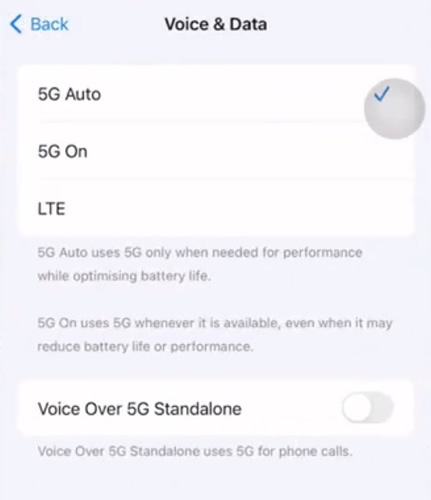
If you have all that, then you should check the required settings are enabled. If you have an iPhone, then head to Settings > Mobile Service > Voice & Data, and enable the toggles for both ‘5G Standalone’ and ‘Voice over 5G Standalone’.
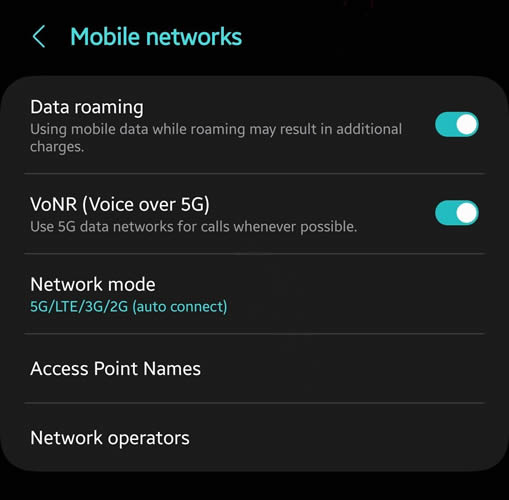
If you have an Android phone then the exact options may vary depending on your device, but EE says to head to Settings > Connection > Mobile Networks, and set ‘Network Mode’ to ‘5G’, and turn the ‘VoNR’ toggle on.
Additionally, as noted, EE's 5G Standalone is only available in select locations. The network hasn’t provided a full list, but we know this includes:
Altrincham, Bath, Belfast, Birmingham, Blackburn, Bradford, Bridgend, Bristol, Caerphilly, Cardiff, Corby, Cwmbran, Doncaster, Edinburgh, Exeter, Glasgow, Huddersfield, Hull, Hyde, Leeds, Leicester, Liverpool, London, Manchester, Middlesbrough, Milton Keynes, Port Talbot, Rotherham, Sale, Sheffield, Sunderland, Wakefield, Walkden, and Wilmslow.
Vodafone
Vodafone offers 5G Standalone – which it calls 5G+ – on “selected Vodafone Pay Monthly plans, and on eligible devices.” At the time of writing that includes the likes of its SuperMobile plans, but look for a mention of ‘5G+’ in the plan description to be sure.
Voice over 5G should automatically be activated if you have a compatible plan and device.
O2
To enable Voice over 5G on O2 you’ll need an R15 SIM and a compatible device – a full list of which can be found here. If you have both of those, it should automatically switch on.
How can I tell if I have Voice over 5G Standalone?
If you have Voice over 5G Standalone you should find a VoNR or similar toggle on your phone’s setting screen, but another way to test is to make or receive a call when you have a 5G Standalone connection, and see if the network signal on your device changes to something else, such as 4G.