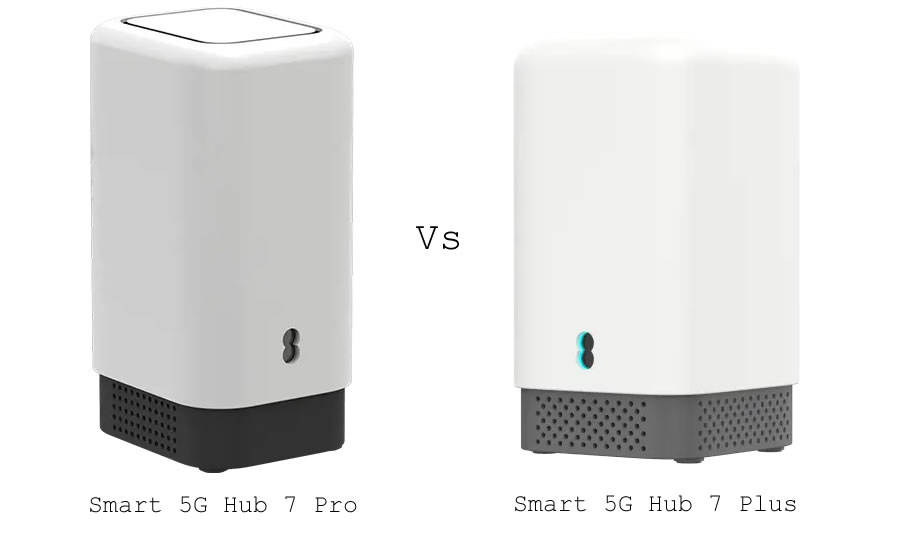
EE currently sells two different home broadband devices, but at a glance you might struggle to tell much difference between them.
They have very similar names for a start, with one being called the EE Smart 5G Hub 7 Pro and the other being called the EE Smart 5G Hub 7 Plus. And they look similar too, as they’re large, mostly white rectangles with a black section at the bottom. But there are in fact some differences, which are worth knowing about before you order either.
The EE Smart 5G Hub 7 Plus is what you’ll get if you order a 4G plan
The EE Smart 5G Hub 7 Plus (which is a rebranded Askey HH72C) is the only option if you specifically want a 4G home broadband plan on EE.
However, if you want a 5G plan then you can order either device — just make sure you select a 5G plan rather than a 4G one if you order the 7 Plus.
For reference, EE claims that you can expect average download speeds of 40Mbps with a 4G plan on the Smart 5G Hub 7 Plus, while both of these devices are said to deliver average download speeds of 146Mbps with 5G.
The EE Smart 5G Hub 7 Pro costs more
The EE Smart 5G Hub 7 Pro (a rebranded Askey HH70C) costs more than the Smart 5G Hub 7 Plus — even if you choose 5G plans for both.
There are reasons for this, which we’ll get to below, but looking just at 5G plans, the EE Smart 5G Hub 7 Plus currently starts at £45 per month with £100 upfront. For that, you’ll get an 18-month plan with 500GB of monthly data. If you want unlimited data you’ll pay £50 per month with £100 upfront.
The EE Smart 5G Hub 7 Pro meanwhile is only available on an 18-month unlimited data plan at the time of writing, and this costs £55 per month with £100 upfront. So in other words you’re paying £5 per month extra for an equivalent plan with the Smart 5G Hub 7 Pro.
EE Smart 5G Hub Pro
£55.00 a month18 month contract
The EE Smart 5G Hub 7 Pro supports tri-band connectivity
The biggest difference in capabilities between these devices is that the Smart 5G Hub 7 Pro is tri-band, while the Smart 5G Hub 7 Plus is just dual-band.
That means both support the 2.4GHz and 5GHz bands, but the EE Smart 5G Hub 7 Pro additionally supports the 6GHz band. Being able to leverage the 6GHz band means it’s not limited to the other two – often congested – bands, allowing for faster and more consistent performance.
Indeed, EE claims that this makes it ideal for the busiest homes, while it describes the Smart 5G Hub 7 Plus as being perfect for “everyday family use.”
Almost everything else is the same
For the most part, other than slight design differences, the other features of these devices are identical. That includes support for Wi-Fi 7, and the ability to get over 100 devices online.
One other possible difference is the number of Ethernet ports, as while most pages on EE’s site list both devices as having two (a 1Gbps one and a 2.5Gbps one), images of the EE Smart 5G Hub 7 Plus show three, and the manual for it linked on EE’s site also mentions three (the third being another 1Gbps one). So it’s unclear what’s going on there.
Still, this is unlikely to make much difference to most people. So if you want the most capable device, you should go for the EE Smart 5G Hub 7 Pro. But if you don’t need cutting-edge tech then you could save some money with the Smart 5G Hub 7 Plus — and it’s the only option for 4G plans.