Three tends to do very well in 5G speeds tests, and the latest results are no exception, with Ookla having put out its testing results for the second half of 2025, which show Three in the lead across most metrics.
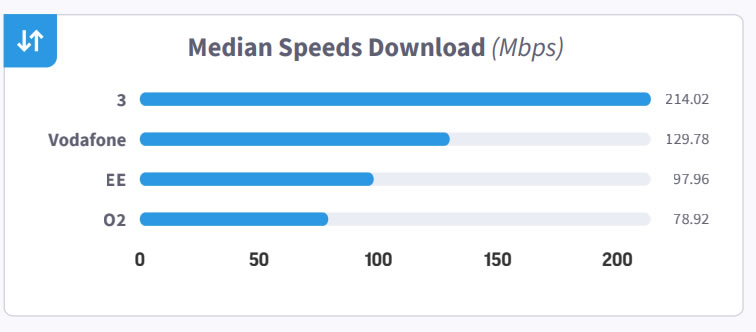
Three’s most notable win is for median 5G download speeds, where it achieved 214.02Mbps. Even though that’s slightly lower than its 227.77Mbps result in the first half of 2025, it’s still way ahead of the competition, with Vodafone taking second place at 129.78Mbps, followed by EE with 97.96Mbps, and then O2 at 78.92Mbps.
It’s a similar story with 90th percentile download speeds (those being the top 10% of recorded speeds on each network). Three’s result here is 654.15Mbps, Vodafone’s is 364.30Mbps, EE’s is 326.01Mbps, and O2’s is 268.42Mbps.
Even when their networks are at their worst with their 10th percentile speeds, Three’s is still best, with Ookla recording a speed of 33.80Mbps for Three, 19.55Mbps for Vodafone, 11.87Mbps for O2, and 8.98Mbps for EE.
Ahead on uploads too
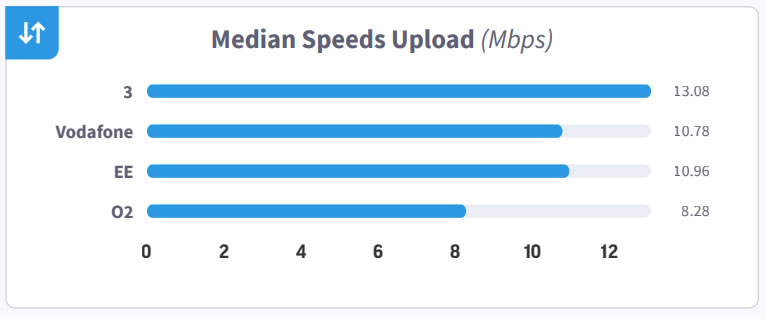
Three fares almost as well relative to rivals for upload speeds too. Its median 5G upload speed was found to be 13.08Mbps, while EE’s was 10.96Mbps, Vodafone’s was 10.78Mbps, and O2’s was 8.28Mbps, and Three also led for 90th percentile upload speed at 69.08Mbps – though its 10th percentile 5G upload speed was just 1.42Mbps, which saw it beaten by Vodafone at 1.61Mbps.
Loaded latency was also measured – that being the latency when the connection is under heavy use. For that, Three again topped the charts when it came to downloads, with a median of 405.93ms, while O2 was last at 1039.19ms, as lower is better here.
For loaded latency uploads though, Three actually came last at 700.52ms, while Vodafone did best at 520.56ms.
Still, overall Three is the clear winner across these tests, achieving a ‘Speed Score’ from Ookla of 53.46. Vodafone was rated second overall at 43.05, followed by EE at 36.73, and then O2 at 30.70.
Of course, now that Vodafone and Three have merged, we’ll likely start seeing their networks become more unified, which could soon mean these scores will change – but since they already have the top two scores, it’s likely that Three – or VodafoneThree – will retain its lead.